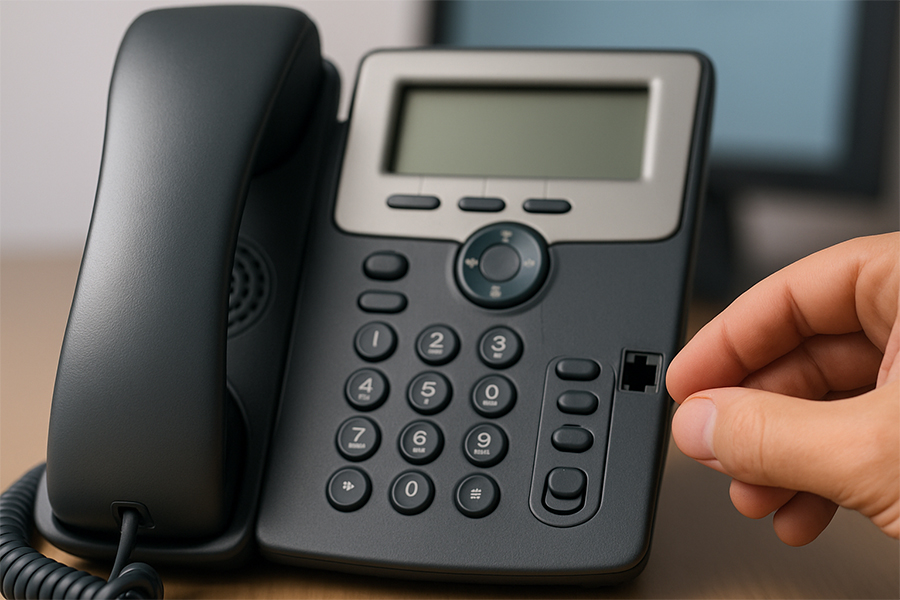


Reliable connectivity now extends far beyond office computers. IoT SIMs are giving businesses a flexible way to keep essential equipment, people and locations connected.
Reliable connectivity is no longer simply about keeping office computers online. Businesses now depend on an increasing number of connected devices, from security systems and payment terminals to vehicle trackers, lift alarms and temporary workspaces.
This is where Internet of Things (IoT) SIMs are making a real difference.
Unlike a conventional mobile SIM used in a telephone, an IoT SIM is designed to connect equipment, systems and machines to a mobile data network. It gives businesses a flexible way to keep essential technology connected, particularly where fixed broadband is unavailable, impractical or not sufficiently resilient.
As more business processes become connected, IoT SIMs are helping organisations operate more efficiently, respond more quickly and reduce their dependence on traditional fixed-line infrastructure.
What is an IoT SIM?
An IoT SIM allows a device to communicate over a mobile network without needing to connect to a conventional office broadband service.
Depending on the application, it may provide data, voice and text services. It can be installed in a wide range of equipment, including:
- Routers and mobile hotspots
- Security and CCTV systems
- Vehicle-tracking equipment
- Payment terminals
- Environmental monitoring devices
- Lift emergency telephones
- Lone-worker safety devices
- Digital signage
- Smart meters and sensors
Although an IoT SIM may look similar to an ordinary mobile SIM, the service behind it is designed for business equipment rather than everyday mobile telephone use. IoT services can offer features such as private static IP addresses, data monitoring, IMEI locking and access to multiple mobile networks.
Why multi-network connectivity matters
 A standard mobile SIM normally connects to one network. If that network has poor coverage or experiences a local outage, the connected device may lose service.
A multi-network IoT SIM can access several UK mobile networks, depending on the selected service. An unsteered multi-network SIM does not permanently favour one particular network, allowing it to connect to a suitable available network in its location.
This can provide an important additional level of resilience for equipment that needs to remain connected.
It is particularly valuable for businesses operating across multiple sites or deploying equipment in different parts of the country. Instead of carrying out a separate coverage assessment and arranging a different network for every location, a multi-network solution gives each device greater flexibility to use the coverage available locally.
No mobile service can guarantee uninterrupted connectivity in every location, but access to multiple networks can significantly reduce the business risk associated with relying on a single provider.
Keeping businesses operational when broadband fails
Even a reliable fixed broadband connection can occasionally develop a fault. Without a backup, businesses may lose access to cloud applications, payment systems, emails, telephones and other essential services.
An IoT SIM installed in a compatible 4G or 5G router can provide automatic connectivity failover. If the main broadband service becomes unavailable, the router switches to the mobile connection so that essential operations can continue. Once the fixed service is restored, the router can switch back automatically.
This can be particularly important for businesses that cannot afford to stop trading simply because their primary connection has failed.
Retailers may need to continue processing payments, professional services firms may require access to cloud systems, and healthcare providers may depend on connected applications to deliver their services. In these situations, mobile failover is no longer just a convenient extra; it can form an important part of a business continuity plan.
Connecting temporary and new locations
Installing a fixed broadband or Ethernet service can take time. However, a business may need to begin operating from a new site immediately.
A managed 4G or 5G solution, combining an IoT SIM with a suitable router, can provide connectivity while the permanent service is being installed. This is sometimes referred to as a pre-Ethernet or pre-broadband solution.
The same approach can be used for:
- Construction and development sites
- Temporary offices
- Pop-up shops and events
- Seasonal business locations
- Home and remote offices
- Mobile or relocatable operations
- Emergency recovery sites
Because the equipment can be installed relatively quickly, businesses do not necessarily have to delay opening a location while waiting for fixed infrastructure.
For some temporary or remote sites, mobile connectivity may even provide a practical long-term solution.
Supporting the move away from traditional telephone lines
 IoT SIMs also have an important role to play in the UK’s digital telephone switchover.
The traditional Public Switched Telephone Network (PSTN) is being retired, with businesses expected to have migrated affected services by January 2027. The change does not only affect ordinary telephone calls. Equipment such as alarm systems, telecare devices, door-entry systems and lift emergency telephones may also depend on traditional analogue lines and will need to be checked.
Voice-enabled IoT SIMs can provide an alternative for certain applications, including lift emergency auto-diallers. A suitable mobile solution can allow an emergency system to make calls without depending on an old analogue landline.
However, emergency and safety-critical equipment must be assessed carefully. Compatibility, coverage, power resilience, installation requirements and the equipment manufacturer’s recommendations should all be considered before an existing line is replaced.
The priority is not simply to remove the old telephone line. It is to make sure the service continues to operate safely and reliably after the change.
Helping to protect lone and remote workers
Businesses also have a responsibility to consider the safety of employees working alone or away from a fixed location.
Connected lone-worker devices can provide voice, data and text communication, allowing employees to request assistance or send an alert when necessary. When combined with multi-network connectivity, these devices have a greater opportunity to find available coverage in areas where one individual network may be weak.
This is useful for employees working in areas such as:
- Construction
- Utilities and maintenance
- Healthcare and social care
- Security
- Property management
- Transport and logistics
- Field engineering
Connectivity cannot replace appropriate risk assessments, training and safety procedures, but it can provide an important communication link between a lone worker and their employer or monitoring service.
Making connected technology easier to deploy
One of the biggest advantages of IoT connectivity is its flexibility.
A business can select anything from a low-data tariff for equipment that sends occasional status updates to a much larger data allowance for CCTV, mobile broadband or other data-heavy applications. Services can therefore be matched more closely to the actual job the device performs.
Managed solutions can also combine the SIM, router and required configuration into one package. This makes it easier to deploy a ready-to-use service without the business having to source and configure each component separately.
Additional options may include:
- 4G or 5G connectivity
- Multi-network or single-network services
- Private or public static IP addresses
- Usage monitoring and alerts
- Inclusive voice minutes and text messages
- Device or IMEI locking
- Data allowances ranging from very small to very large
- Flexible or longer-term agreements
The right combination will depend on the application, location, required level of resilience and likely data usage.
Choosing the right IoT solution
 The term “IoT SIM” covers a wide range of services, so it is important not to select a solution based on price or data allowance alone.
Before making a decision, a business should consider:
- What is being connected? A backup router, lift alarm and vehicle tracker will all have very different requirements.
- How critical is the connection? If a loss of service would create a safety, financial or operational risk, resilience should be a priority.
- Where will the equipment be used? A fixed device at one known address may have different network requirements from equipment that travels across the country.
- How much data will it use? Small monitoring devices may transmit very little data, while CCTV and mobile broadband can consume considerably more.
- Does it need voice or text services? Some applications require data only, whereas lift alarms and lone-worker devices may also require calls and text messages.
- Is a static IP address required? Remote access, monitoring and certain security applications may require a fixed public or private IP configuration.
- What happens during a power failure? For critical systems, the resilience of the equipment and its power supply is just as important as the SIM itself.
Understanding these requirements at the outset helps prevent a business from paying for unnecessary features—or discovering too late that its chosen service is unsuitable.
IoT connectivity is becoming part of everyday business
IoT SIMs are not just for major technology companies or large-scale industrial projects. They are already supporting everyday business activities, from keeping card machines and offices online to protecting lone workers and replacing ageing fixed-line services.
Their main advantage is the ability to connect equipment quickly and flexibly, without depending entirely on fixed infrastructure. Multi-network options can add further resilience, while managed solutions make the technology easier to introduce and maintain.
As businesses become increasingly reliant on connected equipment and cloud-based systems, IoT connectivity will play a growing role in business continuity, safety and operational efficiency.
I am text block. Click edit button to change this text. Lorem ipsum dolor sit amet, consectetur adipiscing elit. Ut elit tellus, luctus nec ullamcorper mattis, pulvinar dapibus leo.
Talk to RGC
RGC can help businesses identify the most suitable IoT connectivity for their equipment, locations and operational requirements. Whether you need multi-network IoT SIMs, mobile broadband, connectivity failover or a voice-enabled solution, we can assess the requirement and recommend an appropriate service.